
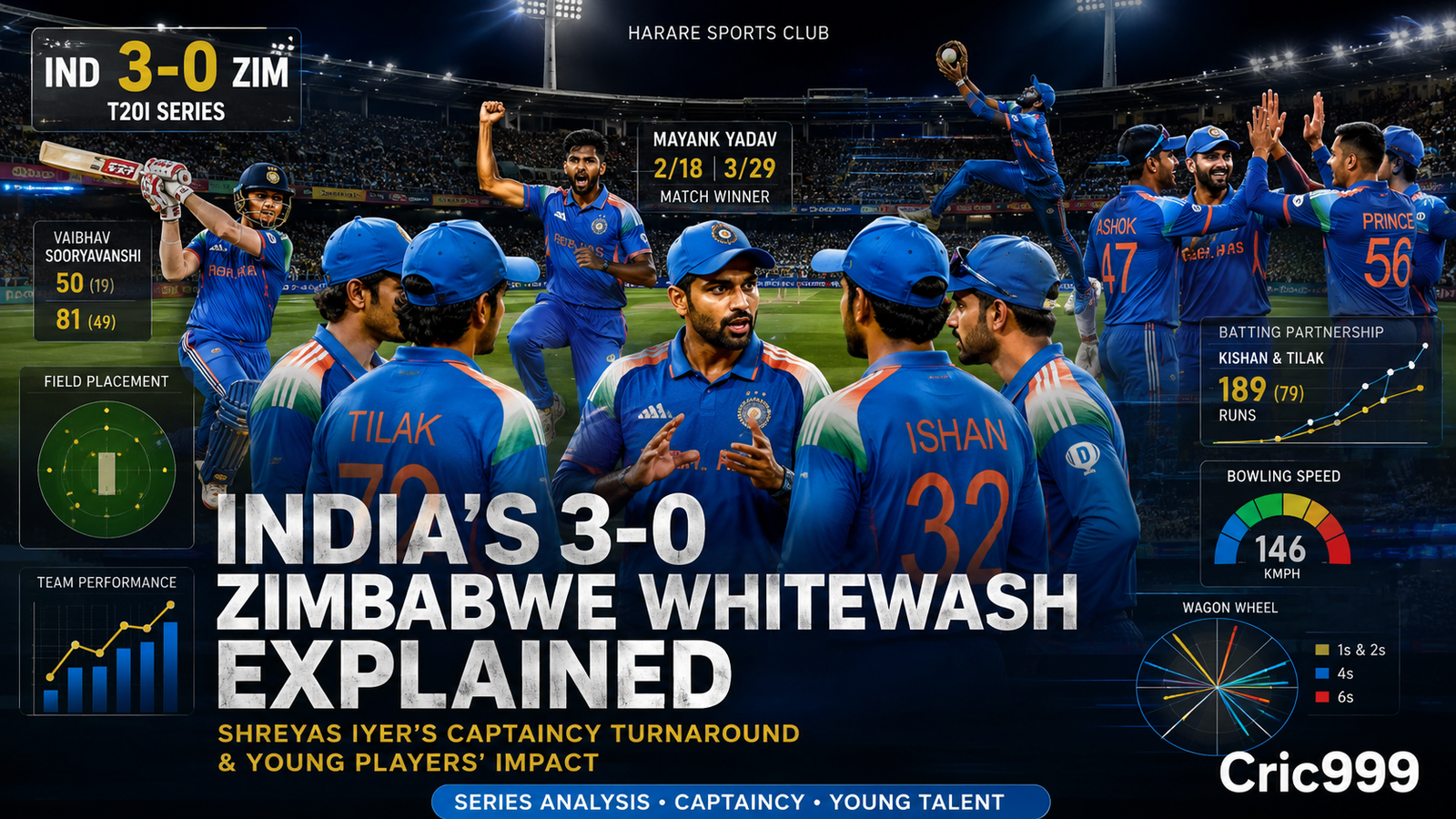
The response from India’s young T20I squad during the tour of Zimbabwe was significant. Shreyas Iyer’s team won all three matches at Harare Sports Club through a comfortable chase, a strong defence and a controlled victory in the final match.
For Cric999 readers, however, the most important takeaway goes beyond the 3-0 scoreline. India found better rhythm through clearly defined roles, versatile bowling options and fearless batting. Nevertheless, a single bilateral series against less experienced opposition cannot resolve every selection concern. Instead, it should be viewed as a positive indication of India’s increasing depth in T20 cricket.
An Overview of India’s 3-0 Series Victory
| Match | Result | Key Turning Point |
| 1st T20I | India won by 7 wickets | Mayank Yadav’s 2/18 and Vaibhav Sooryavanshi’s 50 from 19 balls |
| 2nd T20I | India won by 90 runs | Ishan Kishan’s 81 and Tilak Varma’s unbeaten 60 helped India reach 219/5 |
| 3rd T20I | India won by 35 runs | Sooryavanshi’s 81 and Mayank’s 3/29 helped India defend 192 |
India did not depend on a single approach throughout the series. The bowlers set the stage in the opening match, the batters dominated the second encounter, and both departments contributed effectively in the third match. Therefore, this adaptability made the clean sweep particularly significant.
Shreyas Iyer’s Captaincy Turnaround
Zimbabwe saw a more settled version of Iyer as captain. In the first match, he opted to field and made good use of the early assistance available to Mayank Yadav, Ashok Sharma and Prince Yadav. Their pace and hard lengths reduced Zimbabwe to 32/4, allowing India to take control of the contest.
Iyer also varied his attack intelligently. India used seven bowlers in the second match, including Tilak Varma and Abhishek Sharma. Abhishek’s figures of 3/17 demonstrated the advantage of having flexible bowling options, especially when the opposition was already under scoreboard pressure.
Captaincy should not be measured only by the collection of silverware. Bowling changes, field placements, effective communication and clarity of roles deserve equal importance. When judged on these parameters, India appeared more systematic, while the players looked increasingly comfortable with their assigned responsibilities.
Flexible Roles Helped India’s Young Players Succeed
India’s younger players were assigned different roles throughout the series. Sooryavanshi was given the responsibility of attacking during the powerplay. Kishan combined aggression with innings-building, while Tilak played the role of a stabiliser and finisher. He came to the crease with India at 95/3 and scored a rapid unbeaten 60 from 29 balls.
Similarly, Mayank had a clear responsibility to bowl with pace using the new ball. Bishnoi operated during the middle overs, whereas Yash, Prince and the all-rounders provided flexible options based on the match situation.
When roles are clearly defined, an opener can attack with confidence, allowing the middle order to manage risk more carefully. The best T20 strategies provide players with clear responsibilities while also allowing them enough freedom to adapt to changing situations.
India’s Batting Intent Defined the Strategy
Sooryavanshi struck 50 from only 19 balls, while Kishan and Iyer supported him with scores of 35 and 28 respectively. As a result, India comfortably chased the target of 126 in just 13.2 overs.
The second match provided an even stronger example of sound batting tactics. After ten overs, India were 95/3. Kishan and Tilak then carried the score to 189 before the next wicket fell. Kishan scored 81 from 44 balls, while Tilak maintained the momentum with an unbeaten 60 from 29 deliveries.
Controlled aggression was also visible in the final match, where Sooryavanshi scored 81 from 49 balls and guided India to 192/5. This approach showed that India could attack appropriate deliveries, rotate the strike and preserve enough batting resources for the final overs.
Bowling Discipline Created Consistent Pressure
In both the first and third matches, Mayank dismissed Brian Bennett with the first ball of the innings. He finished with figures of 2/18 in the opening match and 3/29 in the final encounter. Raw pace became even more dangerous when combined with greater discipline, accurate lines and hard lengths.
India’s collective bowling strength was particularly visible in the second match. Zimbabwe moved from 34 without loss to 49/4 before eventually being dismissed for 129. Abhishek claimed three wickets, while Yash and Prince collected two wickets each.
Furthermore, consistent dot balls forced Zimbabwe’s batters to attempt riskier shots. India combined pace, spin, control and slower deliveries, preventing the hosts from building comfortable partnerships. This section also provides a natural connection for Cric999 readers interested in Mayank Yadav’s comeback against Zimbabwe.
Fielding and Match Awareness
India’s ground fielding and boundary protection generally supported their bowling plans. Catchers were positioned for mistimed pull shots and lofted strokes, while the larger boundaries at Harare allowed the bowlers to direct batters towards less comfortable scoring areas.
However, India’s catching was not perfect. According to the available series statistics, India completed 18 catches but also dropped 10 opportunities, including five missed chances in the third match.
Although those errors did not affect the final series result, stronger teams are more likely to punish repeated mistakes. Consequently, the whitewash showed clear progress while also identifying an important area that requires further improvement.
Where Zimbabwe Lost Tactical Control
Zimbabwe lost too many early wickets and consequently placed significant pressure on their middle order to rebuild the innings. They were reduced to 32/4 in the opening match, lost four wickets within 15 runs during the second encounter and slipped to 34/3 in the final game.
Ryan Burl, Wessly Madhevere and Tadiwanashe Marumani offered resistance at different stages. However, the lack of substantial partnerships prevented Zimbabwe from building complete innings.
A similar pattern affected their bowling. After achieving early breakthroughs, Zimbabwe struggled to restrict the scoring rate. This was especially evident when India recovered from 29/2 and eventually reached 219/5 in the second match.
Nevertheless, Zimbabwe can still gain valuable lessons from the series. Competing against a deeper and more skilled team highlights weaknesses in middle-over strike rotation, finishing power and the ability to maintain disciplined bowling plans throughout all 20 overs.
What the Whitewash Means for India’s T20 Future
Sooryavanshi was named Player of the Match in the final encounter and also received the Player of the Series award. Kishan produced an important innings, Tilak performed effectively as a finisher, and Mayank consistently generated pace and wickets.
Therefore, the series strengthened the competition for places in India’s future T20 squad. It also provided the team management with more information about the abilities of young Indian cricketers.
Still, one successful tour should not guarantee permanent selection. India must test these players against stronger bowling attacks, different pitches and higher-pressure tournaments.
The main benefit of the series is increased squad depth and a clearer understanding of which players can open aggressively, rebuild an innings, finish strongly or bowl during specific phases of a T20 match.
Cric999 Online Safety Reminder During Trending Cricket Series
As online traffic increases during major cricket events, online scams may also increase. Readers should remain cautious of false news pages, lookalike domains, impersonation accounts and suspicious cricket APK files.
People searching for an Online Betting ID may be redirected towards fraudulent pages that request OTPs, UPI PINs, passwords or other financial details. Never share such information with unknown websites, messaging accounts or social-media profiles.
Always check the complete website address before opening a link. In addition, avoid suspicious downloads and do not approve unexpected payment requests. This Cric999 article focuses on cricket analysis and online-safety awareness. RBI and CERT-In also recommend that users never disclose their PINs or OTPs and avoid untrusted links and APK files.
Final Cric999 Analysis
Clearly defined roles, structured aggression and early wickets all contributed to India’s 3-0 victory. Iyer used his bowling options effectively, while Sooryavanshi, Kishan, Tilak, Mayank and the supporting bowlers ensured that India’s success remained a collective effort.
The balanced Cric999 view is that the Zimbabwe series provided a useful opportunity for player development. However, stronger opposition will present more demanding challenges. India must maintain the clarity demonstrated during this series while continuing to improve their catching, adaptability and decision-making under pressure.
Frequently Asked Questions
1. What were the main reasons for India’s 3-0 T20I series win against Zimbabwe?
Early wickets, adaptable batting and contributions from several players shaped the series. India successfully chased 126 in the first match and defended totals of 219 and 192 in the next two encounters. Contributions from different players also prevented the team from becoming dependent on one individual.
2. What was different about Shreyas Iyer’s captaincy during the Zimbabwe series?
Iyer adapted his bowling options according to the conditions, assigned clear roles to younger players and maintained pressure through flexible plans. India’s tactics appeared more organised, and the players remained calm. However, stronger opponents will provide a more demanding test of his captaincy.
3. Which young Indian players made the greatest impact?
Sooryavanshi was named Player of the Series after scoring 50, 20 and 81. Mayank created a major bowling impact, while Tilak, Prince and Yash made valuable contributions during important phases of the three-match series.
4. What does the whitewash mean for India’s future T20I team?
The result indicates the strength of India’s bench and increases competition for places. However, future selections should also consider performances against stronger opposition, adaptability to different conditions, fitness and consistency over a longer period rather than depending on one successful series.
5. Does this Cric999 article provide an Online Betting ID?
No. This article provides cricket analysis and digital-safety information. It does not provide or activate an Online Betting ID. Readers should never share one-time passwords, UPI PINs, account passwords or identity documents with unknown contacts or suspicious websites.