
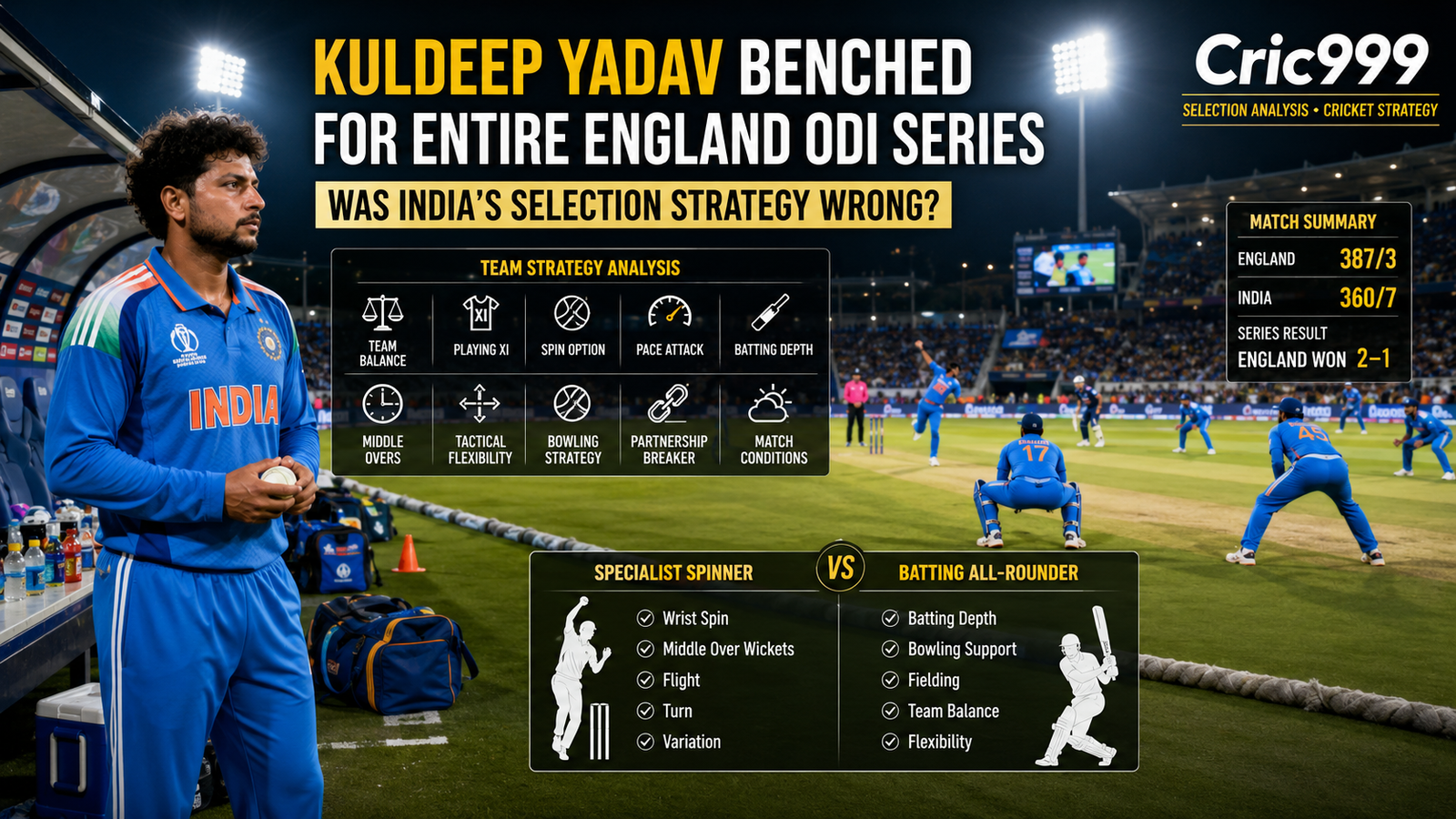
Kuldeep Yadav was in India’s ODI squad in England, yet he didn’t play any of the matches. India preferred more batting depth, and more seam and all-round options. Ravichandran Ashwin added to the debate and asked how the constant axing of a bowler would affect confidence and bowling rhythm.
The Kuldeep Yadav England ODI Series 2026 debate is how India provides a balance of a bowling all-rounder who is an attacking wrist spinner, as opposed to all-rounders who provide multiple skills. This analysis on Cric999 takes both sides into consideration.
Kuldeep Yadav England ODI Series Omission Reasoning
Kuldeep was part of the original 15-man squad to be selected. He was still not included in the playing XI in any of the matches.
The first ODI was won by India, while England won the next two, taking the Series 2-1.
| Match | Venue | Playing Status | Selected Spin Options | Result |
| 1st ODI | Edgbaston | Not Selected | Axar Patel, Washington Sundar | Won by six wickets |
| 2nd ODI | Sophia Gardens | Not Selected | Axar Patel, Washington Sundar | Lost by four wickets |
| 3rd ODI | Lord’s | Not Selected | Axar Patel | Lost by 27 runs |
In the first two ODIs, both Axar Patel and Washington Sundar got selected, while Axar was the only spin option in the decider at Lord’s.
So, why was Kuldeep Yadav left out? There was no official word provided. But, as claimed, batting depth, the playing conditions, and balance of the team, were most likely reasons, although they are more tactical assumptions than direct reasons for not selecting him.
What Did Ravichandran Ashwin Say About Handling Kuldeep?
Ashwin said that not selecting a bowler consistently can affect their rhythm and their confidence. This concern strengthened around the Lord’s decider since India opted for four frontline fast bowlers and Axar as the sole spinner even with the injuries adjusting the planned combination.
He even questioned the management’s faith in Kuldeep. That remains expert opinion and is not an official comment from the Indian selectors or the coaching staff.
Thus, Ashwin’s criticism is of the selection and not of the management’s reasoning.
Why Kuldeep Yadav Could Have Been an Asset to the Indian Bowling Unit
Kuldeep is arguably the only Indian bowler who provides left-arm wrist-spin and can be an attacking bowler by spinning the ball and varying the length and the pace.
Kuldeep can perform middle-over wicket taking which prevents the opposition from building and preparing for a final overs assault.
Thus, Kuldeep could have offered a breaking the partnership option at Lord’s since England’s opening batters had total domination with a lengthy phase of their batting, where Ben Duckett and Jacob Bethell opened the batting for England with a partnership of 192 runs and England subsequently scored 387 for 3.
Kuldeep’s different style of bowler would have offered the batters a different tactical problem of planning for wrist-spin.
Why India May Have Gone For All Rounders Insttead
This option was fully reasonable from India as it added depth in batting with Axar and Washington Sundar and also added the spin option.
Axar Patel justified his selection in the 1st ODI by taking 4 wickets and scoring an unbeaten 50 as India chased down 259.
All-rounders safeguard the lower order and provide adaptable match-ups. If India’s top order collapsed, the captain could still rely on their batting.
If the pitch was fast, their spin could be used more strategically.
I’m not saying that all-rounders are better than Kuldeep. The main advantage is that they provide a balance of bowling along with decent batting, fielding, and options.
Spinner vs Batting All Rounders
| Selection Factor | Specialist Spinner | Batting All-Rounder |
| Primary Value | Wicket-taking bowling | Multiple Skills |
| Batting Depth | Usually Limited | Generally Stronger |
| Middle Over Threat | Potentially Higher | Depends on Bowling Role |
| Team Flexibility | Specialized Role | Greater Flexibility |
| Main Selection Risk | Longer Batting Tail | Reduced Specialist Threat |
Determine the pitch and opposing team to make the right selection. Some teams don’t have the ability to maintain a competitive balance.
A specialist spinner may actually be more advantageous when the opposite team is making partnerships with little resistance.
On the other hand, all-rounders may be advantageous when the bowling attack lacks wicket-taking opportunities and the batting order is less assured.
Was a Middle-Over Wicket Taker a Must?
There is varying evidence. Axar got 4 wickets and bowled the tail out at Edgbaston who batted out to 258.
At Cardiff, India had England at 60 for 3 and then at 125 for 5, but Joe Root’s 99 not out led England to victory.
At Lord’s, the opening pair of Duckett and Bethell put on a stand of 192 and India’s bowlers failed to take wickets.
From the series, India made wicket-taking pressure in certain segments. The more precise question is, once the batters got into their rhythm, did the attack have enough variation?
Dot balls build pressure, and consistently getting wickets forces batters to start their rhythm all over again.
Kuldeep may have offered a route through flight, turn and deception, but that’s just a tactic and is not enough to prove a different outcome in the series.
Was It a Mistake to Select Kuldeep?
It was defensible thinking from India. Axar and Washington gave them a longer batting tail, and English conditions made it sensible to go with pace.
The first win justified that combination, and Axar did a great job in both innings. Irrespective of that, it’s a concern that India did not use Kuldeep in all three different places with different conditions and scenarios.
In the decider, Washington Sundar and Jasprit Bumrah were not available, but India still chose a pace-heavy attack with Axar as the main spinner. England then built partnerships and scored 387/3.
Kuldeep may have offered the best chance to win, but India still bowled poorly and fielded an inexperience attack, and Shubman Gill, the captain, accepted that in the post-match interview.
The Kuldeep case deserves more concern, as in some of the matches, the strategy was fine. However, it was too rigid and did not focus enough on Kuldeep’s role and what he could bring.
The situation and perspective may have shifted after Cardiff or prior to Lord’s.
What’s Ahead for Kuldeep Yadav in ODIs
Kuldeep Yadav needs clarity on his role. A bowler cannot stay on the sidelines too long and maintain his rhythm.
They will also need to know the conditions that will give them a chance to play.
Not playing in this ODI series doesn’t end his ODI career. However, it does present the question of how India views him.
Is he a first-choice spinner, or does he serve as a backup in case of an emergency?
He will need opportunities in the future to compete in ODIs and bowl in enough matches to get the rhythm he will need for competitive matches.
If the goal is to evaluate him fairly, he will need to be given some opportunities. The way he will be given opportunities will need to be consistent.
Managing India’s Team
India will need to give Kuldeep Yadav a clear role on the team so that he knows where he will fit.
There needs to be enough flexibility in the team to ensure that the depth in the batting order will not come at the expense of wickets.
There should be communication with players on the bench. If a specific tactical issue has been solved, it may be worth a try to go back to other combinations in the past.
Betting Your ID Online
We do not provide betting IDs online. Do not share sensitive data like One Time Passwords, documents, bank details, etc. with agents that you do not know.
Online betting has so many regulations that it is nearly impossible to know where you’ll be operating legally.
Betting on sports comes with a high risk of losing money and should not be viewed as investing. Cricket reports and analyses should be for education and for your knowledge, not financial advice.
Frequently Asked Questions
1. Did Kuldeep Yadav take part in the England ODI series 2026?
No, Kuldeep was included in the Indian squad. However, he did not play any of the three ODIs at Edgbaston, Sophia Gardens, and Lord’s.
2. What were the reasons Kuldeep Yadav was not part of India’s playing XI?
There were no specific reasons officially communicated. While there is no direct evidence, it seemed India valued depth in batting, versatility in all-rounders and control, and balance from pace-focused bowling.
3. What was Kuldeep’s comment regarding Ashwin on Yadav?
Ashwin raised concerns about the management’s faith in Kuldeep, adding that constant omissions may adversely influence a specialist bowler’s confidence, and may disrupt the bowler’s rhythm and role in the team.
4. In ODIs, is Kuldeep Yadav Superior to a batting all-rounder?
In essence, both provide something distinct. Kuldeep is more of a strike bowler, while batting all-rounders are versatile. The situation should help make that call.
5. Was India’s strategy in the series against England incorrect?
The Kuldeep Yadav England ODI Series 2026 approach was reasonable in the beginning, but not giving him a chance to play in any of the three ODIs showed that India’s strategy was not flexible.
Conclusion
Kuldeep’s being left out shows India’s inclination towards choosing players with more batting depth, flexible all-rounders, and seamers.
That judgment actually helped win the first match, but in later matches, situations arose where a specialist wrist-spinner could have been useful.
In Cric999‘s view, that strategy was logical but inflexible. Kuldeep’s continued absence was one of the reasons for India’s series loss, and that decision certainly deserves more consideration.
Future squad management would greatly benefit from better communication and clarity regarding roles and more flexibility in the application of selection criteria.