
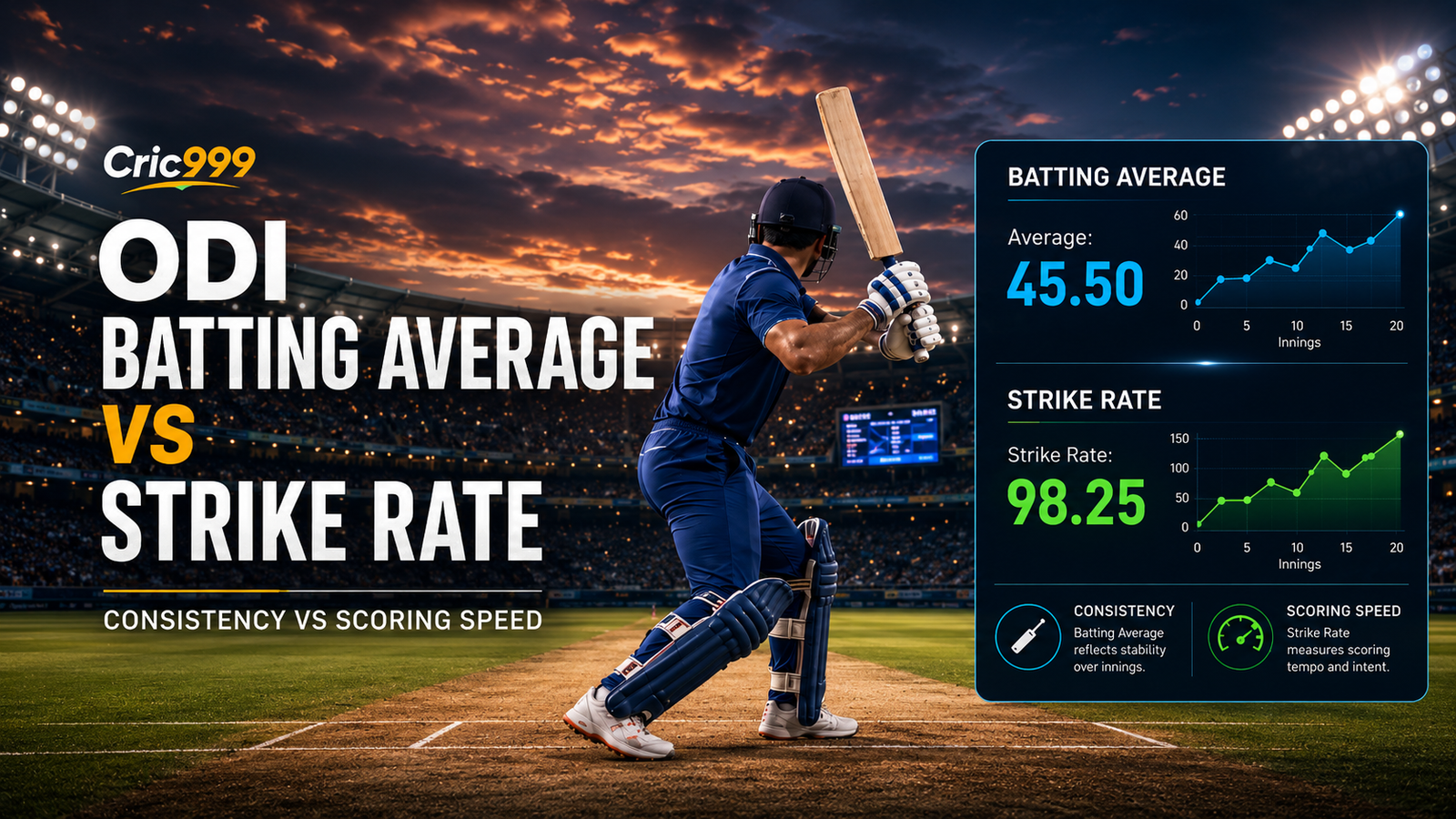
Batting average and strike rate are two statistics frequently used in cricket. For beginners, both statistics describe batting performance, which can cause confusion. However, they do not measure the same quality.
In ODI cricket, comparing batting average and strike rate becomes easier once you understand both calculations. A batting average shows how consistently a player scores, while a strike rate shows how quickly a player scores.
This Cric999 guide explains both statistics through simple equations, illustrations and match situations. More importantly, it explains when one statistic may carry greater importance than the other.
ODI Batting Average vs Strike Rate: Quick Answer
A batting average shows how many runs a player scores for every dismissal. In contrast, a strike rate shows how many runs a player scores per 100 balls.
Therefore, batting average shows a player’s consistency, while strike rate shows a player’s scoring speed. For a complete picture, cricket fans should evaluate both statistics because one figure cannot communicate a player’s full value.
| Factor | Batting Average | Batting Strike Rate |
| What it measures | Runs per dismissal | Runs per 100 balls |
| Main purpose | Measures consistency | Measures scoring speed |
| Calculation | Runs divided by dismissals | Runs divided by balls faced × 100 |
| Higher figure usually shows | Greater reliability | Faster scoring |
| Main match value | Stability | Scoring tempo |
What Is Batting Average in ODI Cricket?
In ODI cricket, batting average shows how many runs a player scores before getting out. It focuses on the number of dismissals rather than the number of innings.
For instance, a batter can play 10 innings and remain not out in two of them. As a result, the batter will have eight dismissals. However, runs from all 10 innings still count in the calculation.
Therefore, a batter who remains not out can improve their batting average by scoring runs without losing their wicket.
A high ODI batting average usually reflects a greater level of consistency. However, it does not explain the scoring rate, pitch difficulty or pressure created by the match situation.
In addition, a small sample can misrepresent a player’s average. For example, a new batter may have a high average after only two or three recorded innings. Therefore, cricket fans should consider the number of matches, innings and dismissals before judging performance.
What Is the Formula for Batting Average?
Use the following formula:
Batting Average = Total Runs Scored ÷ Number of Dismissals
For example, assume a batter scores 250 runs across six innings and gets dismissed five times.
250 ÷ 5 = 50
Therefore, the player’s batting average is 50.
As another example, consider a player who scores 180 runs across four innings and remains not out in one innings. Thus, the player has three dismissals.
180 ÷ 3 = 60
In this case, the batting average is 60, not 45.
This example illustrates that innings played and dismissals recorded are not always equal. A not-out innings adds to the total runs scored, but it does not add to the dismissal count.
What Is Batting Strike Rate in ODI Cricket?
Batting strike rate indicates how quickly a player scores runs. It shows the scoring rate per 100 balls faced.
However, the batter does not need to face exactly 100 balls to apply the formula. Cricket statisticians can calculate strike rate after any number of legal deliveries.
A strike rate of 100 means the batter scores one run per delivery. Meanwhile, a strike rate of 80 represents 80 runs per 100 deliveries. A strike rate of 120 represents 120 runs per 100 deliveries.
A higher strike rate generally helps a team reach a stronger total. Moreover, a faster scoring rate puts greater pressure on the bowling side.
However, cricket followers should also consider the match situation. A strike rate of 75 may look slow on a batting-friendly pitch. In contrast, the same strike rate may represent a useful performance on a difficult surface.
How Is Batting Strike Rate Calculated?
Use the following formula:
Batting Strike Rate = Total Runs Scored ÷ Total Balls Faced × 100
Suppose a batter scores 75 runs from 60 balls.
75 ÷ 60 × 100 = 125
Therefore, the batter’s strike rate is 125.
Now consider another player who scores 40 runs from 50 balls.
40 ÷ 50 × 100 = 80
This means the player scores at a rate of 80 runs per 100 balls.
However, this result only explains scoring speed. It does not tell us whether the innings helped the team win or whether the batter played on a challenging pitch.
Main Difference Between Batting Average and Strike Rate
Batting average focuses on run accumulation before dismissal. In contrast, strike rate measures the pace at which the batter scores those runs.
Consider two fictitious ODI players:
- Player A has an average of 48 and a strike rate of 82.
- Player B has an average of 39 and a strike rate of 108.
Player A may provide greater stability and consistency. On the other hand, Player B may score quickly and change the momentum of a match.
Therefore, one player cannot automatically rank above the other. Their batting positions, team strategies and match situations can greatly affect their value.
Batting Average vs Strike Rate in Different Match Situations
| Match Context | Why Average Matters | Why Strike Rate Matters |
| Opening the innings | Shows consistent contributions at the top | Shows powerplay scoring speed |
| Middle overs | Shows the ability to build an innings | Shows whether the batter maintains pressure |
| Death overs | Has limited value when viewed alone | Shows the ability to score rapidly |
| Difficult pitch | Shows patience, survival and reliability | Must be judged according to conditions |
| Run chase | Shows whether the batter can provide stability | Shows whether the batter maintains the required run rate |
| Player comparison | Shows long-term consistency | Shows attacking impact and scoring tempo |
Openers, anchors and finishers perform different jobs. Therefore, cricket fans should interpret each player’s statistics according to their role.
For example, an opener usually needs to score consistently while also using the powerplay. Meanwhile, a finisher often faces fewer balls and focuses on scoring quickly during the final overs.
What Is Considered a Good Batting Average in ODI Cricket?
There is no defined standard for every ODI batter. Factors such as batting position, playing era and sample size affect how cricket followers should evaluate an average.
However, the following ranges can provide useful starting points for beginners:
- Less than 25 may indicate limited consistency, although the player’s role matters.
- An average between 30 and 40 is respectable for many ODI positions.
- An average of 40 or above usually indicates strong consistency.
- An average of 50 or above is generally exceptional over a significant career.
Cricket followers should assess lower-order batters differently. For instance, a lower-order batter with a modest average may still play a quick, match-winning innings.
In addition, a new player’s average can change significantly after only a few matches. Therefore, sample size remains an important consideration.
What Is a Good Strike Rate in ODI Cricket?
A good strike rate in ODI cricket depends on batting position, required run rate, pitch conditions, playing era and team strategy.
However, the following ranges can provide a useful reference:
- Less than 70 usually appears slow in modern ODI cricket, although difficult conditions may justify it.
- A strike rate between 70 and 90 may represent controlled or measured ODI scoring.
- A strike rate between 90 and 100 usually represents a good modern ODI scoring rate.
- A strike rate above 100 generally represents aggressive scoring over a meaningful sample.
In addition, a finisher often records a higher strike rate because they bat during the final overs. Conversely, an anchor batter may score more slowly while focusing on stability.
Why Both Statistics Must Be Analysed Together
When cricket fans consider only one statistic, they often gain an incomplete picture.
For example, a player may have a high batting average but a low strike rate. This combination may show consistency, but it may also indicate slow scoring.
Alternatively, a player may have a high strike rate but a low batting average. In this case, the player scores quickly but may struggle to build long innings.
A score of 70 runs from 100 balls may provide an excellent contribution on a difficult pitch. However, the same innings may slow the team on a batting-friendly surface.
Likewise, a player may score only 35 runs from 20 balls. Although the score looks small, it may become a valuable contribution during the final overs of a close match.
Cric999 encourages readers to evaluate batting position, opposition quality, pitch conditions, match situation and sample size alongside both statistics.
Which Is More Important in ODI Cricket?
Neither statistic holds greater importance in every situation.
Batting average shows reliability and consistency. Meanwhile, strike rate shows scoring speed and the ability to apply pressure.
Top-order batters usually need a balance of both qualities. However, cricket analysts may judge finishers more heavily on strike rate. Anchor batters, on the other hand, often carry greater responsibility for stability.
Ultimately, the match situation determines which quality matters more.
During a difficult chase, consistency may carry greater value. However, when the batting team falls behind the required run rate, scoring speed becomes more important.
Common Mistakes When Analysing ODI Batters
Comparing Players from Different Eras
Directly comparing ODI batters from different eras can create misleading conclusions. Modern ODI cricket often features faster scoring rates, different fielding restrictions and changing team strategies.
Ignoring Batting Position
Different batting positions involve different responsibilities. Therefore, cricket followers should evaluate averages and strike rates according to each batter’s role.
Analysing Very Few Matches
A small number of matches provides an incomplete picture. As a result, long-term records usually offer a more reliable basis for comparison.
Considering Only Career Statistics
Career statistics provide useful information. However, they may not accurately reflect a player’s recent form or current role.
Ignoring Match Conditions
Pitch conditions, bowling quality and match pressure can affect scoring speed. Therefore, fans should always consider the context surrounding an innings.
Key Metrics for ODI Batter Analysis
Before comparing ODI batters, examine the following factors:
- Career batting average
- Career strike rate
- Number of innings
- Recent form
- Batting position
- Performance in run chases
- Home and away performance
- Quality of opposition
- Contributions to match outcomes
- Pitch conditions
- Statistical context of the match
Frequently Asked Questions
What Is the Difference Between Batting Average and Batting Strike Rate?
Batting average and batting strike rate both explain a batter’s performance. Average shows how consistently the batter scores before getting dismissed. In contrast, strike rate shows how quickly the batter scores runs. Therefore, both statistics require proper match context.
How Is Batting Average Calculated in ODI Cricket?
Divide the total runs scored by the number of times the batter gets dismissed. Runs from not-out innings still count, but those innings do not count as dismissals. Therefore, innings played and dismissals may differ.
How Is Batting Strike Rate Calculated?
Divide the total runs scored by the number of balls faced. Then, multiply the result by 100. For example, 60 runs from 50 balls produce a strike rate of 120.
Is a Batting Average of 50 Good in ODI Cricket?
Yes. A batting average close to 50 usually represents excellent consistency over a meaningful career. However, cricket followers should also consider the playing era, sample size, batting role and strike rate.
Is a Strike Rate of 100 Good in ODI Cricket?
Yes. A strike rate of 100 means the batter scores one run per ball. It generally represents a good scoring rate in modern ODI cricket. However, batting role and pitch conditions still affect its value.
Which Is More Important, Batting Average or Strike Rate?
Neither statistic is always more important. Batting average shows consistency, while strike rate shows scoring speed. Therefore, the match situation, batting role and team requirements determine which statistic carries greater value.
Conclusion
To analyse batting properly, fans need to understand ODI batting average vs strike rate.
Batting average captures the consistency with which a player scores before dismissal. In contrast, strike rate measures how quickly the batter scores runs. However, cricket fans cannot analyse either number in isolation. Sample size, batting position, pitch conditions, opposition quality and match impact all affect these statistics.
An anchor may focus on stabilising the innings, while a finisher may try to score as quickly as possible. Cric999 recommends using both statistics together. This approach provides a clearer and more balanced understanding of ODI batting performance.